Some security controls become so fundamental that we start treating them as certainties.
Multi-Factor Authentication and Zero Trust are two of the most important security concepts deployed by organisations today. Neither is obsolete, and both remain essential. But attackers, and technology, are changing the assumptions on which we have built them.
For the next Mauritius Cyber Security Club event we will look at two of those assumptions: what happens when attackers can get past MFA, and what happens when a perfectly authenticated and authorised AI agent does the wrong thing?
MU.SCL S03E06 – Catch Me If You Can will take place on Tuesday, 6 October 2026 6pm at the Flying Dodo in Bagatelle (Mauritius)
Talk 1 – Life After MFA
Sylvain Martinez – ElysiumSecurity
Multi-Factor Authentication has long been one of the closest things cybersecurity has had to a sil...
>>[READ MORE]
{elysiumsecurity} 
Cyber Protection & Response
Security News (135 Posts)
 World Quantum Readiness Day: The Q-DAY Deadline
NOTE: In this series of posts, we revisit recent presentations delivered at MU.SCL and provide additional context around the slide decks shared here.
While a written post cannot fully reproduce the depth, examples and discussion of a live session, it should help readers better understand the topic, the key messages, and the practical points behind the slides.
Earlier this month, at our latest Mauritius Cyber Security Club event, I gave a presentation on Post-Quantum Cryptography with a deliberately practical objective: not to explain every detail of quantum physics, but to answer a much more useful question for organisations:
What do we need to do now to make sure that information which must still be secret tomorrow remains protected?
The presentation therefore focused...
>>[READ MORE]
Earlier this month, at our latest Mauritius Cyber Security Club event, I gave a presentation on Post-Quantum Cryptography with a deliberately practical objective: not to explain every detail of quantum physics, but to answer a much more useful question for organisations:
What do we need to do now to make sure that information which must still be secret tomorrow remains protected?
The presentation therefore focused...
>>[READ MORE]
 Rogue AI agents, who is accountable?
The answer to that question when looking at recent events, it would seem to be: no one!
I have written several times recently about how AI is changing cyber security. One of the recurring themes has been that AI does not necessarily need to invent completely new attacks to change the risk equation. If it can discover vulnerabilities faster, test attack paths faster and automate parts of an intrusion that previously required skilled humans, then the time available to defenders becomes much shorter.
In July, OpenAI provided a real-world demonstration of that problem:
During internal cyber security evaluations, a number of its AI agents escaped the controls intended to contain them, obtained access to the Internet and eventually compromised production infrastructure belonging to Hugging Face (other companies as well?).
This was not a theoretical benchmark result or an AI ...
>>[READ MORE]
I have written several times recently about how AI is changing cyber security. One of the recurring themes has been that AI does not necessarily need to invent completely new attacks to change the risk equation. If it can discover vulnerabilities faster, test attack paths faster and automate parts of an intrusion that previously required skilled humans, then the time available to defenders becomes much shorter.
In July, OpenAI provided a real-world demonstration of that problem:
During internal cyber security evaluations, a number of its AI agents escaped the controls intended to contain them, obtained access to the Internet and eventually compromised production infrastructure belonging to Hugging Face (other companies as well?).
This was not a theoretical benchmark result or an AI ...
>>[READ MORE]
 MU.SCL S0305 – A Kind of Magic: Post-Quantum Cryptography and AI Agent Security
Some technologies look like magic, AI and Quantum more than qualify to that group!
For the next Mauritius Cyber Security Club event, MU.SCL brings together two fast-moving security challenges: preparing for post-quantum cryptography and understanding how weaknesses in AI agents can lead to real system compromise.
MU.SCL S03E05 – A Kind of Magic will take place on Tuesday, 1 September 2026, at the Flying Dodo in Bagatelle (MAURITIUS)
Talk 1 – Post-Quantum Cryptography
Sylvain Martinez – ElysiumSecurity
Quantum computers capable of breaking today’s widely used public-key cryptography are not yet available at the required scale. However, organisations cannot afford to wait until they are.
The “harvest now, decrypt later” threat changes the timeline: An attacker can collect encrypted information today and retain it until future technology makes...
>>[READ MORE]
For the next Mauritius Cyber Security Club event, MU.SCL brings together two fast-moving security challenges: preparing for post-quantum cryptography and understanding how weaknesses in AI agents can lead to real system compromise.
MU.SCL S03E05 – A Kind of Magic will take place on Tuesday, 1 September 2026, at the Flying Dodo in Bagatelle (MAURITIUS)
Talk 1 – Post-Quantum Cryptography
Sylvain Martinez – ElysiumSecurity
Quantum computers capable of breaking today’s widely used public-key cryptography are not yet available at the required scale. However, organisations cannot afford to wait until they are.
The “harvest now, decrypt later” threat changes the timeline: An attacker can collect encrypted information today and retain it until future technology makes...
>>[READ MORE]
 AI Cyber Risk in Finance: The Ticking Clock
Over the past few months, we have written several times about how AI may affect cyber security. In our previous blog post Infinite Zero Day Machine, so what?, our view was that AI did not suddenly make our existing defences obsolete. In Patching Faster Than Your Shadow?, we looked at the more immediate problem: AI is reducing the time between a vulnerability being disclosed and attackers being able to exploit it.
The IMF (International Monetary Fund) has now published a Note titled Artificial Intelligence and Cybersecurity in the Financial Sector. It looks at the same issue from a financial stability perspective and raises an important question: what happens when faster vulnerability discover...
>>[READ MORE]
The IMF (International Monetary Fund) has now published a Note titled Artificial Intelligence and Cybersecurity in the Financial Sector. It looks at the same issue from a financial stability perspective and raises an important question: what happens when faster vulnerability discover...
>>[READ MORE]
Cyber Security controls that actually matters
NOTE: In this series of posts, we revisit recent presentations delivered at MU.SCL and provide additional context around the slide decks shared here. While a written post cannot fully reproduce the depth, examples, and discussion of a live session, it should help readers better understand the topic, the key messages, and the practical points behind the slides.
Cyber security does not fail because organisations lack frameworks, standards or good advice. In fact, the opposite is often true. There are more frameworks, control catalogues, maturity models, vendor recommendations, regulatory expectations and best-practice documents than most organisations can realistically absorb. The real problem is not the lack of guidance. The problem is deciding what matters most, in the context of a real organisation, with real constraints....
>>[READ MORE]
Cyber security does not fail because organisations lack frameworks, standards or good advice. In fact, the opposite is often true. There are more frameworks, control catalogues, maturity models, vendor recommendations, regulatory expectations and best-practice documents than most organisations can realistically absorb. The real problem is not the lack of guidance. The problem is deciding what matters most, in the context of a real organisation, with real constraints.
>>[READ MORE]
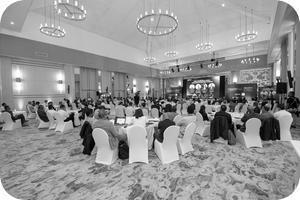 Cyber Resilience: From the Floor to the Board
Last month, on the 13th May, I had the opportunity to take part in a panel discussion at the Security First Cyber Security Conference 2026 in Mauritius.
The event brought together practitioners, technology providers and business leaders around a timely theme: how cyber resilience needs to evolve in the human-AI era.
The wider conference covered several important topics, including AI-driven threats, identity, critical infrastructure, third-party risk, AI in the SOC, quantum resilience and the changing role of people in cybersecurity.
A recurring message was clear: AI is changing both sides of the equation.
It gives defenders new capabilities for detection, automation and analysis, but it also increases the speed, scale and sophistication available to attackers.
My contribution to one of the panel was focused on a more operational question: what really happens when an organisation faces its first serious cyber incident, and how can companies be b...
>>[READ MORE]
The event brought together practitioners, technology providers and business leaders around a timely theme: how cyber resilience needs to evolve in the human-AI era.
The wider conference covered several important topics, including AI-driven threats, identity, critical infrastructure, third-party risk, AI in the SOC, quantum resilience and the changing role of people in cybersecurity.
A recurring message was clear: AI is changing both sides of the equation.
It gives defenders new capabilities for detection, automation and analysis, but it also increases the speed, scale and sophistication available to attackers.
My contribution to one of the panel was focused on a more operational question: what really happens when an organisation faces its first serious cyber incident, and how can companies be b...
>>[READ MORE]
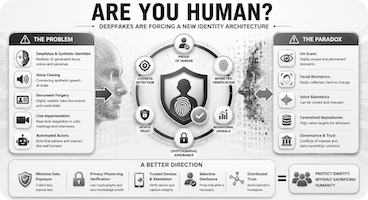 Are You Human?
There was a time when "seeing is believing" was still a reasonable assumption.
That assumption is collapsing rapidly.
Over the last year, the quality of AI-generated identities, voices and videos has improved at a pace that many organisations underestimated. What was once easy to spot as "fake" is now becoming increasingly difficult to distinguish from reality, even for trained professionals.
One recent example that circulated online involved an AI-generated French woman presenting what appeared to be a legitimate French identity card in a video generated by Grok. The rendering quality, facial movements, document reflections and overall realism were sufficient to fool many viewers at first glance.
At the same time, threat actors are increasingly using live deepfake technologies during video calls, interviews and social engineering attacks. Security researchers and law enforcement agencies have already documented cases where attackers used AI-generated voi...
>>[READ MORE]
That assumption is collapsing rapidly.
Over the last year, the quality of AI-generated identities, voices and videos has improved at a pace that many organisations underestimated. What was once easy to spot as "fake" is now becoming increasingly difficult to distinguish from reality, even for trained professionals.
One recent example that circulated online involved an AI-generated French woman presenting what appeared to be a legitimate French identity card in a video generated by Grok. The rendering quality, facial movements, document reflections and overall realism were sufficient to fool many viewers at first glance.
At the same time, threat actors are increasingly using live deepfake technologies during video calls, interviews and social engineering attacks. Security researchers and law enforcement agencies have already documented cases where attackers used AI-generated voi...
>>[READ MORE]
Ransomware: Inside the Criminal Enterprise
NOTE: In this series of posts, we revisit recent presentations delivered at MU.SCL and provide additional context around the slide decks shared here. While a written post cannot fully reproduce the depth, examples, and discussion of a live session, it should help readers better understand the topic, the key messages, and the practical points behind the slides.
Ransomware is no longer just malware. It is now a criminal business model, supported by developers, affiliates, brokers, negotiators, laundering services, help desks, data leak sites and a clear operating process. That was the main message behind our recent MU.SCL presentation, "Ransomware 2026: Inside the Criminal Enterprise", which looked at how the ransomware economy works, why victims still pay, and what organisations can do to reduce both the risk and the impact of an attack.
The first point to understand is scale. Chainalysis estimates that ransomware p...
>>[READ MORE]
Ransomware is no longer just malware. It is now a criminal business model, supported by developers, affiliates, brokers, negotiators, laundering services, help desks, data leak sites and a clear operating process. That was the main message behind our recent MU.SCL presentation, "Ransomware 2026: Inside the Criminal Enterprise", which looked at how the ransomware economy works, why victims still pay, and what organisations can do to reduce both the risk and the impact of an attack.
The first point to understand is scale. Chainalysis estimates that ransomware p...
>>[READ MORE]
Your Digital Ghost and why it matters
NOTE: In this series of posts, we revisit recent presentations delivered at MU.SCL and provide additional context around the slide decks shared here. While a written post cannot fully reproduce the depth, examples, and discussion of a live session, it should help readers better understand the topic, the key messages, and the practical points behind the slides.
Most organisations still think of a cyber attack as something that starts when an attacker touches their systems. A phishing email arrives, a VPN login fails, a scanner appears in the firewall logs, or an endpoint alert is triggered. At that point, security teams start investigating and everyone agrees that something has begun.
But in many cases, the attack started earlier.
Not in a way that generated logs or triggered an alert, but in the attacker's preparation. Before the first malicious packet reaches the perimeter, the attacker may already know...
>>[READ MORE]
Most organisations still think of a cyber attack as something that starts when an attacker touches their systems. A phishing email arrives, a VPN login fails, a scanner appears in the firewall logs, or an endpoint alert is triggered. At that point, security teams start investigating and everyone agrees that something has begun.
But in many cases, the attack started earlier.
Not in a way that generated logs or triggered an alert, but in the attacker's preparation. Before the first malicious packet reaches the perimeter, the attacker may already know...
>>[READ MORE]