 Cyber Attacks: From Stealing Data to Threatening Lives
A technical malfunction? No, a cyber attack!
WHAT HAPPENED?
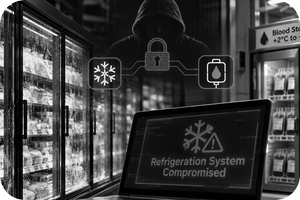
According to a report published by the French authorities on 9 November, approximately 700 retail sites in France were targeted during the night of 11 to 12 October 2026. Attackers manipulated refrigeration settings, causing significant stock losses and at least 15 outbreaks of fire.A second wave of attacks in early November affected supermarkets across several other European countries.
More worryingly, on 2 November, a compromise of a refrigeration provider affected three sites of the French Blood Establishment (EFS). Temperature and defrost settings were raised, putting blood products at risk. Fortunately, alarms and rapid staff intervention prevented any losses, according to the French health authorities.
The French authorities attributed the October attack to a cyber offensive unit linked to Iran's Islamic Revolutionary Guard Corps, with sabotage and destabilisation identified as objectives. Whether the November incidents involved the same attackers has not been established.
A SOPHISTICATED ATTACK?
Not particularly, according to the technical analysis published by Sekoia on 10 November.The investigation highlighted refrigeration controllers directly accessible from the Internet and running outdated firmware. Attackers altered temperature settings, defrost schedules and even the thresholds used to trigger alarms. The exact vulnerability exploited during the first wave has not been confirmed.
What I find particularly interesting is that the attackers did not need to destroy the controllers themselves. Manipulating the equipment's existing functionality was sufficient to cause physical damage.
Why disable a system when you can make it work against its owner?
IS THIS EVEN ON YOUR CYBER SECURITY RADAR?
Refrigeration is just one example of Operational Technology (OT) that can easily fall outside the scope of traditional IT security. Think about air conditioning, water pumps, building management systems or generators.Many legacy OT systems were designed for reliability, availability and safety, rather than cyber security. They were not intended to be connected to the Internet, and security is often an afterthought when remote access is introduced. Updating them is not always straightforward either: equipment can remain in service for decades, and patches may require downtime, testing or vendor intervention.
These systems are often installed and remotely managed by external maintenance providers. But who is responsible for their cyber security?
For organisations in Mauritius, particularly supermarkets, hotels, food distributors and hospitals, there are a few questions worth asking:
- Do we know which of our operational systems are connected to the Internet, including those managed by third parties?
- Is remote maintenance access properly secured and are the controllers supported and patched?
- Can we detect abnormal physical conditions independently of the system controlling the equipment?
- Could a single vulnerability affect all our sites simultaneously, and have we planned for that scenario?
This last point is particularly important and is discussed in an interesting Cloud Security Alliance research note on the risks associated with shared refrigeration technology.
CONCLUSION
We spend a lot of time discussing data confidentiality and ransomware, but the integrity of our systems and the physical processes they control deserve just as much attention.Your corporate network may be well protected, your backups may be working and your customer data may be perfectly safe.
And yet, you could still lose an entire warehouse of food overnight or compromise vital medical supplies.
When cyber attacks can have consequences for human life, can we really afford to leave OT outside the scope of our cyber security strategy?